
Multi-cluster Kubernetes: When You Actually Need It
Most teams don't need multi-cluster Kubernetes. Here's when you do — and the 5 operational drivers that justify the cost. Practical guide for platform teams.
THNKBIG Team
Engineering Insights
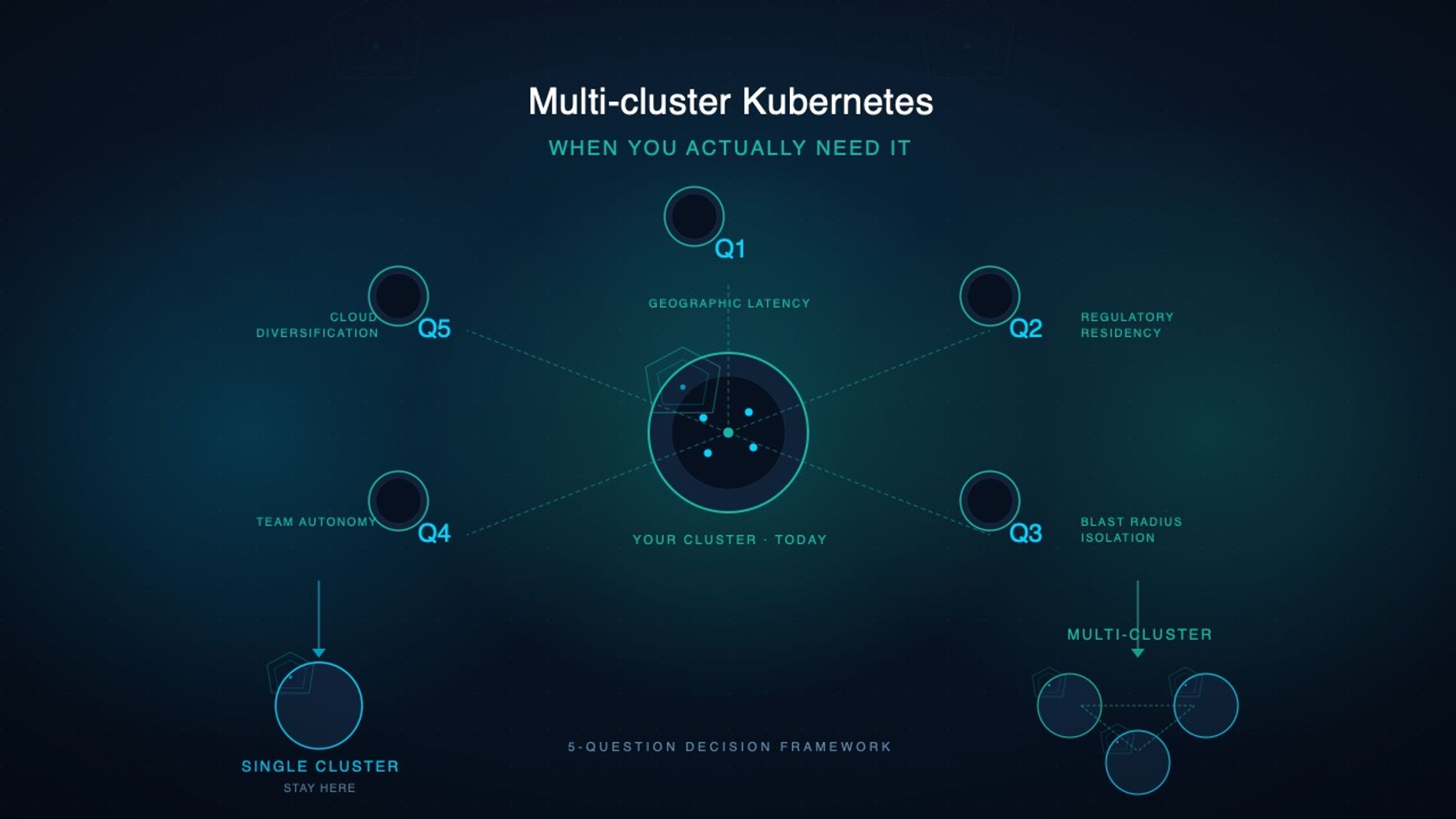
Kubernetes multi cluster when needed — most platform teams don't reach for that complexity until workload topology forces it. The complexity tax — operational overhead, cross-cluster networking, state synchronization, duplicated tooling — is real, and most teams pay it before they need to. At THNKBIG, we see the same pattern across our production deployments: teams adopt multi-cluster because it sounds strategic, then spend 18 months fighting operational complexity that doesn't match their actual workload requirements.
This post focuses on the *when*. The broader architecture patterns and trade-offs are covered in our [multi-cluster strategy guide](/blog/kubernetes-multi-cluster-strategy/) — we'll reference that where it helps, but the core question here is simpler: does your workload actually justify multi-cluster, and if so, which pattern?
Why This Question Matters
Multi-cluster Kubernetes isn't a maturity milestone. It's an operational decision that adds cost, complexity, and blast radius. Every additional cluster adds:
- Operational overhead (upgrades, monitoring, patching — multiplied)
- Networking complexity (cross-cluster service discovery, east-west traffic, DNS federation)
- State synchronization challenges (eventual consistency, replication lag, conflict resolution)
- Tooling duplication (CI/CD, observability, secrets management — every cluster needs its own)
- Increased blast radius for misconfigurations (a bad policy in cluster A can cascade)
We at THNKBIG have watched platform teams adopt multi-cluster preemptively — because a conference talk made it sound important, because a consultant recommended it for "future-proofing," because a CISO wanted geographic redundancy. Most of those clusters sat underutilized for 12+ months before someone questioned the cost.
The hard part: most of those *valid* use cases don't show up until you're already in production with real traffic. By then, you're either retrofitting complexity into an architecture that didn't anticipate it, or you're paying for clusters you don't need.
The 5 Operational Drivers That Justify Multi-Cluster
Multi-cluster is the right answer when one of these is true. None of them — including high availability — is sufficient on its own.
Driver 1: Geographic Distribution for Latency
If your users are spread across regions, and your application can't tolerate 100ms+ cross-region latency, multi-cluster with regional traffic routing is the right pattern. Example: a payment processing API serving users in US, EU, and APAC needs response times under 50ms in each region — running a single cluster in us-east-1 with global DNS routing won't meet that SLA.
**What this costs you:** Active-active deployment, data residency constraints, regional compliance variations (GDPR in EU, data localization in APAC), cross-region replication latency for any stateful workload.
**What this buys you:** Latency that matches user geography, regional failure isolation, regulatory compliance.
Driver 2: Regulatory and Data Residency
Data residency laws — GDPR, HIPAA, regional financial regulations — sometimes *require* workloads to stay in specific jurisdictions. A healthcare SaaS serving EU patients may need PHI workloads running in EU-resident clusters. A financial services platform operating in multiple regulated jurisdictions may need workload segregation per region.
**What this costs you:** Compliance audit overhead per region, regional certification maintenance (SOC 2, ISO 27001, FedRAMP), operational segregation.
**What this buys you:** Regulatory compliance, audit defensibility.
Driver 3: Blast Radius Isolation
Some workloads are too critical to share a control plane with. If a misconfiguration in your experimentation cluster could take down payment processing, multi-cluster with strict isolation is the answer. We at THNKBIG have seen this pattern most often in financial services and healthcare — where a noisy-neighbor failure in dev could cascade into a production incident.
**What this costs you:** Operational segregation, separate RBAC, separate upgrade cadences, separate observability stacks.
**What this buys you:** Failure containment, reduced regulatory scope per cluster.
Driver 4: Cloud Vendor Diversification
Avoiding lock-in through multi-cloud or hybrid deployments is a *legitimate* multi-cluster driver — but only if you're actually committed to the operational cost of running Kubernetes across cloud boundaries. Most teams underestimate this cost by 5-10x. Running EKS + GKE + AKS simultaneously means three sets of IAM models, three networking architectures, three storage abstractions, three upgrade pipelines.
**What this costs you:** Cloud-specific expertise, multiplied infrastructure cost, cross-cloud networking (usually VPN or dedicated interconnect), operational complexity that grows non-linearly.
**What this buys you:** Vendor leverage, regional coverage gaps filled, exit optionality.
Driver 5: Team or Business Unit Autonomy
When different teams or business units need independent control planes — for governance, for organizational reasons, for security boundaries — multi-cluster gives them autonomy. This is a legitimate driver, but it's almost always an *organizational* driver, not a technical one. The technical pattern (Cluster API, federation) is well-understood; the *political* pattern (who owns what, how do clusters get provisioned, who pays the bill) is where multi-cluster projects fail.
**What this costs you:** Centralized governance overhead, federated identity, cross-cluster policy enforcement.
**What this buys you:** Team velocity, organizational clarity.
When You Don't Need Multi-Cluster
Be honest with yourself on these. If any of these is your actual driver, single-cluster is probably the right answer.
- **"High availability"** — single-cluster Kubernetes with proper pod disruption budgets, anti-affinity rules, multi-AZ control plane (etcd HA), and node auto-repair gives you 99.95%+ availability for most production workloads. Multi-cluster HA only matters when your SLA exceeds that, or when your risk model includes control plane failure.
- **"Future-proofing"** — Kubernetes federation patterns have evolved significantly over the last 5 years. Building for a future requirement that may not materialize locks you into current operational patterns. Build for what you need now; refactor when you need something different.
- **"Dev/staging/prod separation"** — namespaces with proper RBAC, network policies, and resource quotas give you logical separation within a single cluster. Multi-cluster is overkill unless you have hard isolation requirements.
- **"Microservices need cross-cluster communication"** — service mesh (Istio, Linkerd) within a single cluster handles this. Cross-cluster service mesh is operationally complex and rarely justified.
- **"Disaster recovery"** — backup and restore patterns (Velero, etcd snapshots) cover most DR scenarios. Multi-cluster active-passive DR is expensive and rarely tested.
The Right Pattern for Your Driver
Different drivers point to different patterns. From our [multi-cluster strategy guide](/blog/kubernetes-multi-cluster-strategy/), the four common patterns are active-passive DR, active-active, federation (Cluster API), and service mesh federation. Each fits a different driver:
| Driver | Recommended Pattern | Why |
|--------|---------------------|-----|
| Geographic latency | Active-active with regional clusters | Users get regional latency; data residency per region |
| Regulatory residency | Active-passive or regional isolation | Compliance audit scope per region; minimum viable |
| Blast radius isolation | Cluster API federation with strict RBAC | Policy enforcement; separate upgrade cadences |
| Cloud diversification | Cluster API across cloud providers | Vendor-neutral abstraction layer |
| Team autonomy | Federation (Cluster API or Karmada) | Self-service cluster provisioning per team |
The wrong pattern — say, federation for blast radius isolation — adds operational overhead without buying you the isolation benefit.
Federation vs Multi-Cluster: What's the Difference
Federation is a specific multi-cluster pattern: a central control plane (Cluster API or Karmada) manages multiple clusters declaratively. "Multi-cluster" is the umbrella term that includes federation *and* active-active, active-passive DR, service mesh federation, and ad-hoc cluster topologies.
Federation makes sense when you need:
- Consistent policy across clusters (security, RBAC, network policies)
- Centralized workload placement and lifecycle
- Declarative cluster provisioning (Cluster API templating)
Federation doesn't make sense when:
- You only need DR (active-passive without federation is simpler)
- Your clusters have fundamentally different requirements (dev vs prod often shouldn't share a control plane)
- Your team is small (federation adds operational overhead that doesn't amortize)
If you're evaluating federation, our [Kubernetes consulting practice](/solutions/kubernetes-consulting/) works with platform teams on this exact decision weekly. The honest answer is usually "it depends on your workload topology" — not "always use federation."
Multi-Tenancy as a Separate Decision
Multi-tenancy (running multiple tenants in the same cluster) is sometimes conflated with multi-cluster. They're different problems:
- **Multi-tenancy:** Multiple teams or customers sharing one cluster, isolated via namespaces, RBAC, network policies, and resource quotas. Cost-efficient, operationally simpler.
- **Multi-cluster:** Multiple independent clusters for the reasons above. Costlier, operationally complex, justified by specific drivers.
If your "multi-cluster" requirement is actually about tenant isolation, single-cluster multi-tenancy with proper sandboxing is usually 80% of the benefit at 20% of the cost.
What We See in Production
Across the production deployments THNKBIG supports, the most common multi-cluster drivers (in order of frequency) are:
1. **Geographic latency** for end-user-facing APIs (most common)
2. **Regulatory residency** for healthcare and financial services
3. **Blast radius isolation** for platform teams running mixed-criticality workloads
4. **Team autonomy** in larger organizations with multiple platform teams
5. **Cloud diversification** (least common — usually not worth the operational cost)
The least common legitimate driver is high availability as a standalone requirement — most teams overestimate their HA needs and underestimate the operational cost of multi-cluster HA.
Decision Framework: A 5-Question Test
Before adopting multi-cluster, answer these five questions. If you can't answer "yes" to at least one, single-cluster is probably the right answer.
1. **Does your workload have hard latency requirements that geographic distribution addresses?** (Driver 1)
2. **Are you subject to data residency laws that mandate geographic segregation?** (Driver 2)
3. **Is your blast radius risk model incompatible with single-cluster failure modes?** (Driver 3)
4. **Is cloud vendor lock-in a material business risk that justifies multi-cloud Kubernetes?** (Driver 4)
5. **Do multiple teams or business units need independent Kubernetes control planes for governance?** (Driver 5)
If you answered "yes" to one or more, multi-cluster is justified. Map your drivers to the pattern table above. If you answered "no" to all five, save the operational budget and stay single-cluster.
What Comes Next
If you're evaluating multi-cluster and want a second opinion, our [Kubernetes consulting practice](/solutions/kubernetes-consulting/) does these assessments weekly. The standard engagement is a 2-week assessment where we evaluate your workload topology, regulatory constraints, and operational capacity, then recommend either single-cluster optimization, a specific multi-cluster pattern, or — most often — a phased migration path that doesn't require multi-cluster on day one. [Book an Assessment Workshop](/contact/) to walk through your specific workload topology.
The broader strategy and trade-offs across all four multi-cluster patterns are in our [multi-cluster strategy guide](/blog/kubernetes-multi-cluster-strategy/) — start there if you want the architecture patterns, then come back to this post for the "should you actually do this" framing.
If you're cost-constrained and multi-cluster is being driven by an HA or DR requirement rather than a workload topology requirement, our [Kubernetes cost optimization guide](/blog/kubernetes-cost-optimization-practical-guide/) often finds 30-50% savings in single-cluster configurations that eliminate the perceived need for multi-cluster.
The honest answer to "do I need multi-cluster Kubernetes" is usually "not yet" — and the right time to revisit is when one of the five drivers becomes real for your workload.
---
*THNKBIG gives engineers their time back. We work with platform teams on Kubernetes architecture, GitOps pipelines, and multi-cluster strategies that match your actual workload requirements — not the patterns that sound good in conference talks.*
Explore Our Solutions
Related Reading

Kubernetes GitOps & CI/CD Pipelines Guide
Enterprise-grade GitOps workflows and CI/CD pipelines for Kubernetes. Practical guide for CTOs on ArgoCD, Flux, and automated deployment strategies.

Kubernetes Multi-Cluster Strategy: A Practical Guide for Enterprise CTOs
Plan your kubernetes multi-cluster deployment with this enterprise guide. Covers architecture patterns, cross-cluster networking, state management, and implementation roadmap.

Kubernetes HIPAA Compliance in 2026: A Practical Guide for Healthcare CTOs
Kubernetes HIPAA compliance in 2026: HHS OCR enforcement trends, technical controls, audit-ready architecture patterns. A practical guide for healthcare CTOs.
THNKBIG Team
Engineering Insights
Expert infrastructure engineers at THNKBIG, specializing in Kubernetes, cloud platforms, and AI/ML operations.
Ready to make AI operational?
Whether you're planning GPU infrastructure, stabilizing Kubernetes, or moving AI workloads into production — we'll assess where you are and what it takes to get there.
US-based team · All US citizens · Continental United States only