
Kubernetes Multi-Cluster Strategy: A Practical Guide for Enterprise CTOs
Plan your kubernetes multi-cluster deployment with this enterprise guide. Covers architecture patterns, cross-cluster networking, state management, and implementation roadmap.
THNKBIG Team
Engineering Insights

Kubernetes Multi-Cluster Strategy: A Practical Guide for Enterprise CTOs
Enterprise Kubernetes deployments rarely stay single-cluster. As organizations grow, so does the need to run workloads across multiple clusters—whether for high availability, disaster recovery, geographic distribution, or cloud vendor diversification.
Multi-cluster Kubernetes is complex, but it doesn't have to be chaotic. This guide provides enterprise CTOs with a practical framework for designing, implementing, and operating multi-cluster architectures that scale.
Why Multi-Cluster Matters
Business Drivers
Multiple clusters become necessary when:
- **Availability requirements exceed single-cluster capabilities**: RTO/RPO demands require geographic redundancy
- **Regulatory compliance**: Data residency laws mandate certain workloads stay in specific regions
- **Cloud vendor strategy**: Avoiding lock-in through multi-cloud or hybrid deployments
- **Team autonomy**: Different business units or product lines need independent control planes
- **Capacity planning**: Workload isolation for noisy neighbor prevention or dedicated resources
The Complexity Tax
Multi-cluster isn't free. Each additional cluster adds:
- Operational overhead (upgrades, monitoring, patching)
- Networking complexity (cross-cluster communication)
- State synchronization challenges
- Increased blast radius for misconfigurations
- Tooling and process duplication
Ensure the business case justifies the complexity.
Multi-Cluster Architecture Patterns
Pattern 1: Active-Passive DR
One cluster handles production traffic; a second cluster stands ready for disaster recovery.
┌─────────────────────┐ ┌─────────────────────┐
│ Primary Cluster │ │ Secondary Cluster │
│ (us-east-1) │────▶│ (us-west-2) │
│ │ │ │
│ ▶ Active Traffic │ │ Standby (Idle) │
└─────────────────────┘ └─────────────────────┘
│ │
└──────── Sync ──────────┘
(Database replication,
object storage, etc.)
**Best for:**
- Regulatory RTO requirements (30+ minutes)
- Budget constraints preventing active-active
- Workloads with defined recovery procedures
**Challenges:**
- Untested failover until actual incident
- Waste of standby resources
- Data replication latency
Pattern 2: Active-Active
Multiple clusters serve traffic simultaneously, providing true HA and geographic distribution.
┌─────────────────────┐ ┌─────────────────────┐
│ Primary Cluster │ │ Secondary Cluster │
│ (us-east-1) │◀───▶│ (eu-west-1) │
│ │ │ │
│ ▶ Active Traffic │ │ ▶ Active Traffic │
└─────────────────────┘ └─────────────────────┘
│ │
└────── Global DNS ──────┘
(Route 53, CloudFlare,
etc.)
**Best for:**
- Low-latency requirements (users in multiple regions)
- Zero-downtime requirements
- Maximum availability SLAs
**Challenges:**
- Data consistency across regions
- Complex state management
- Higher infrastructure costs
Pattern 3: Federation (Cluster API)
Central control plane manages multiple clusters declaratively. For infrastructure teams managing large-scale deployments, the Cluster API provides a unified approach to cluster lifecycle management.
┌──────────────────────────────────────────┐
│ Federation Control Plane │
│ (Cluster API / Karmada / KubeFed) │
└────────────────────┬─────────────────────┘
│
┌────────────┼────────────┐
▼ ▼ ▼
┌─────────┐ ┌─────────┐ ┌─────────┐
│Cluster 1│ │Cluster 2│ │Cluster 3│
│(prod) │ │(staging)│ │(dev) │
└─────────┘ └─────────┘ └─────────┘
**Best for:**
- Consistent policies across clusters
- Workload portability
- Centralized RBAC and governance
**Challenges:**
- Single point of failure for control plane
- Network latency for cross-cluster operations
- Limited by federation tool maturity
Pattern 4: Service Mesh Federation
Service mesh spans clusters, enabling uniform service-to-service communication.
┌─────────────────────┐ ┌─────────────────────┐
│ Cluster A │ │ Cluster B │
│ ┌─────────────┐ │ │ ┌─────────────┐ │
│ │ Service A │───┼─────┼───│ Service B │ │
│ └─────────────┘ │ │ └─────────────┘ │
└─────────────────────┘ └─────────────────────┘
│ │
└────── Service Mesh ──────┘
(Istio, Linkerd, Cilium)
**Best for:**
- Microservices needing cross-cluster communication
- Consistent observability
- mTLS across cluster boundaries
**Challenges:**
- Network configuration complexity
- Latency considerations
- Service discovery across clusters
Cross-Cluster Networking
Service Discovery
How do services find each other across clusters?
**Option A: DNS-Based**
# External DNS in cluster A
apiVersion: externaldns.k8s.io/v1alpha1
kind: DNSEndpoint
metadata:
name: service-b
spec:
endpoints:
- dnsName: service-b.cluster-b.svc.example.com
recordTTL: 300
recordType: A
targets:
- 10.0.0.100
**Option B: Headless Services with Federation**
apiVersion: v1
kind: Service
metadata:
name: my-service
namespace: default
spec:
type: ClusterIP
clusterIP: None
# Federation propagates this across clusters
**Option C: Service Mesh (Recommended for complex setups)**
- Istio's ServiceEntries
- Linkerd's multicluster extension
- Cilium ClusterMesh
Network Connectivity
Physical or overlay networking between clusters:
| Approach | Use Case | Complexity |
|----------|----------|------------|
| VPC Peering | Same cloud, same account | Low |
| Transit Gateway | Multiple VPCs, hub-spoke | Medium |
| WireGuard/Tailscale | Any network | Low |
| Cloud Interconnect | Hybrid cloud | High |
| VPN | Cross-cloud | Medium |
State Management
Database Strategies
Stateful workloads require careful planning:
**Option A: Synchronous Replication**
- Single database cluster spanning regions
- Strong consistency
- High latency penalty
- Example: CockroachDB, Spanner, YugabyteDB
**Option B: Asynchronous Replication**
- Independent databases per cluster
- Eventual consistency model
- Applications handle reconciliation
- Example: PostgreSQL logical replication, MySQL GTID
**Option C: CQRS Pattern**
- Separate read and write models
- Event sourcing for synchronization
- Maximum flexibility but complexity
- Example: Kafka-based architectures
Configuration Synchronization
Keep configurations consistent across your Kubernetes cost optimization and multi-cluster deployments:
**External Secrets Operator:**
apiVersion: external-secrets.io/v1beta1
kind: ClusterSecretStore
metadata:
name: vault-backend
spec:
provider:
vault:
server: "https://vault.example.com"
path: "secret"
version: "v2"
**GitOps with ArgoCD or Flux:**
- Central Git repository
- Automatic sync to all clusters
- Drift detection and correction
For implementing GitOps across your clusters, see our guide on GitOps and CI/CD pipeline best practices.
Cluster Lifecycle Management
Cluster Provisioning
Choose your provisioning strategy:
| Tool | Best For | Complexity |
|------|----------|------------|
| [Cluster API](https://cluster-api.sigs.k8s.io/) | Large-scale, production | High |
| Terraform | Infrastructure-focused teams | Medium |
| RKE2/Talos | Minimal maintenance | Low |
| Managed EKS/GKE/AKS | Cloud-first organizations | Low |
Upgrade Strategy
Rolling upgrades across clusters require planning:
- **Staged rollout**: Upgrade non-production first
- **Canary clusters**: Test new versions on one cluster before all
- **Version skew policies**: Define supported API server versions
- **Rollback procedures**: Documented and tested
Day-2 Operations
Operational considerations for your multi-cluster setup:
- **Monitoring**: Centralized metrics with Thanos, Cortex, or cloud solutions
- **Logging**: Aggregated logs via Loki, ELK, or cloud logging
- **Alerting**: Unified alerting with Prometheus Alertmanager or custom
- **Backup**: Velero for etcd and persistent volumes
- **Disaster Recovery**: Documented runbooks, regular drills
For comprehensive monitoring strategies, see our article on Kubernetes monitoring and observability.
Security Across Clusters
Zero Trust Networking
Assume breach—verify explicitly. For a deeper dive into securing your Kubernetes infrastructure, see our Kubernetes security best practices guide.
- **Network Policies**: Restrict pod-to-pod communication
- **Service Mesh**: mTLS for all service traffic
- **RBAC**: Least privilege for cluster access
- **Secrets Management**: External secrets, not native Kubernetes secrets
Policy Enforcement
Centralized policy with OPA/Gatekeeper:
apiVersion: constraints.gatekeeper.sh/v1beta1
kind: K8sRequiredLabels
metadata:
name: require-cost-center
spec:
match:
kinds:
- apiGroups: [""]
kinds: ["Namespace"]
parameters:
labels:
- key: "cost-center"
Audit and Compliance
Multi-cluster audit trails:
- **Audit logs**: Kubernetes audit policy for all API calls
- **Centralized logging**: All clusters ship to central log aggregation
- **Compliance reporting**: Automated compliance checks with tools like Kyverno
Cost Optimization
Multi-cluster environments can get expensive. Optimize:
- **Right-sizing**: Match node pools to workload needs
- **Spot instances**: Non-critical workloads on spot/preemptible
- **Cluster consolidation**: Don't over-fragment (avoid one-cluster-per-team)
- **Resource quotas**: Prevent runaway resource consumption
- **Lifecycle automation**: Auto-scale, auto-heal, efficient shutdowns
For detailed cost optimization strategies, see our comprehensive guide to Kubernetes cost optimization.
Decision Framework
When to Add Clusters
Add a new cluster when:
- [ ] Regulatory requirement for data residency
- [ ] Current cluster capacity exhausted
- [ ] Failure domain needs isolation
- [ ] Team autonomy requires separation
- [ ] Disaster recovery requires geographic redundancy
When to Consolidate
Consolidate clusters when:
- [ ] Operational overhead exceeds benefit
- [ ] Teams can be reorganized
- [ ] Technology simplifies operations
- [ ] Cost becomes prohibitive
Implementation Roadmap
Phase 1: Foundation (Weeks 1-4)
- Define cluster topology and connectivity
- Establish networking between clusters
- Deploy GitOps tooling
- Create baseline policies
Phase 2: Workload Migration (Weeks 5-8)
- Migrate stateless workloads first
- Establish data replication patterns
- Implement service discovery
- Configure monitoring and alerting
Phase 3: Optimization (Weeks 9-12)
- Tune performance
- Optimize costs
- Automate operations
- Document runbooks
Conclusion
Multi-cluster Kubernetes is a journey, not a destination. Start simple, validate assumptions, and evolve based on operational learnings.
The right architecture depends on your specific requirements: availability targets, compliance needs, team capabilities, and budget constraints. There's no one-size-fits-all solution, but the patterns in this guide provide a foundation for making informed decisions.
Cluster Federation Tools Comparison
Choosing the right federation approach matters:
| Tool | Maturity | Kubernetes Version | Best For |
|------|----------|-------------------|----------|
| **[Cluster API](https://cluster-api.sigs.k8s.io/)** | Stable (CNCF) | 1.16+ | Infrastructure teams, large deployments |
| **[Karmada](https://karmada.io/)** | Growing | 1.19+ | Multi-cloud, policy-driven |
| **KubeFed** | Stable | 1.16+ (maintenance mode) | Legacy setups |
| **Rancher** | Mature | Any | Single management UI |
Our recommendation: Cluster API for greenfield deployments, Karmada for multi-cloud requirement, Rancher if you need unified management across existing clusters.
Common Pitfalls to Avoid
- **Over-fragmentation**: Don't create clusters "just because". Each cluster adds operational overhead. Start with minimum viable clusters.
- **Ignoring network costs**: Cross-cluster traffic isn't free. Model network costs before architecting chatty workloads across regions.
- **Neglecting failback**: Failover procedures get attention, but failback is often overlooked. Document and test both directions.
- **Skipping chaos engineering**: Test cluster failures intentionally. Tools like Chaos Mesh help simulate failures in controlled ways.
- **Centralized everything**: Avoid creating a "super cluster" that becomes a single point of failure. Distribute intelligence appropriately.
**Planning a multi-cluster Kubernetes deployment?**
Schedule an Assessment Workshop with our team to evaluate your requirements and create a practical architecture roadmap.
[Book Assessment Workshop](#)
Explore Our Solutions
Related Reading
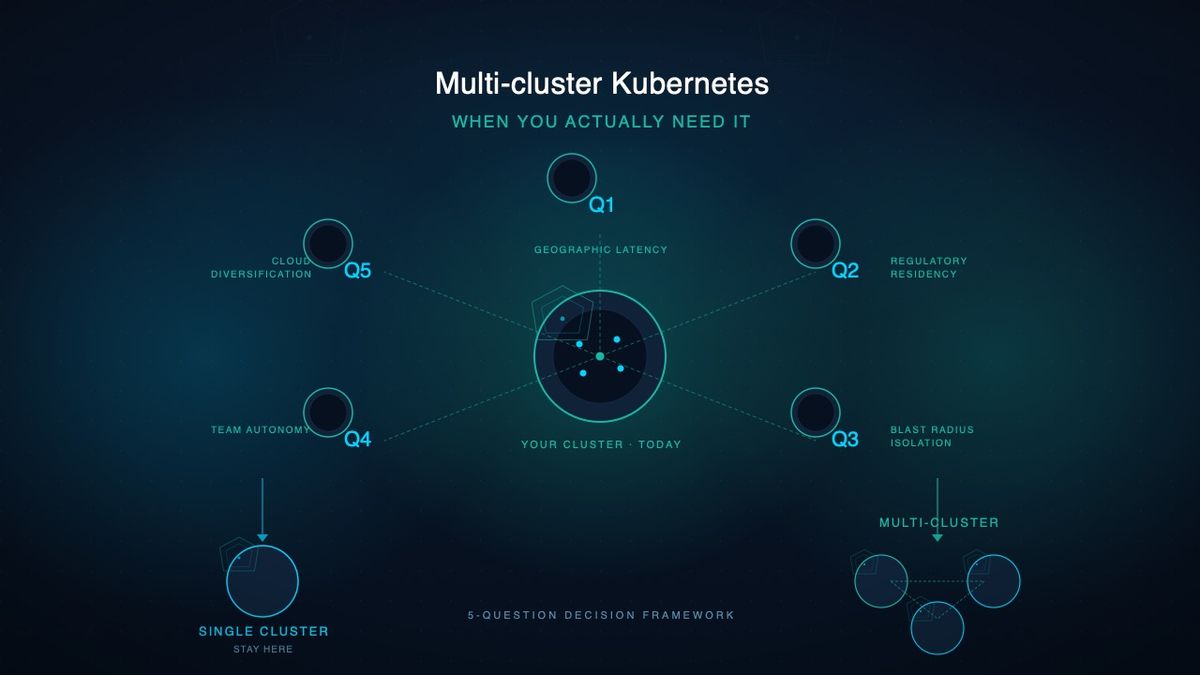
Multi-cluster Kubernetes: When You Actually Need It
Most teams don't need multi-cluster Kubernetes. Here's when you do — and the 5 operational drivers that justify the cost. Practical guide for platform teams.

Kubernetes GitOps & CI/CD Pipelines Guide
Enterprise-grade GitOps workflows and CI/CD pipelines for Kubernetes. Practical guide for CTOs on ArgoCD, Flux, and automated deployment strategies.

Kubernetes HIPAA Compliance in 2026: A Practical Guide for Healthcare CTOs
Kubernetes HIPAA compliance in 2026: HHS OCR enforcement trends, technical controls, audit-ready architecture patterns. A practical guide for healthcare CTOs.
THNKBIG Team
Engineering Insights
Expert infrastructure engineers at THNKBIG, specializing in Kubernetes, cloud platforms, and AI/ML operations.
Ready to make AI operational?
Whether you're planning GPU infrastructure, stabilizing Kubernetes, or moving AI workloads into production — we'll assess where you are and what it takes to get there.
US-based team · All US citizens · Continental United States only